Arm's Length from Reality: How the Selfie Stick Taught Americans to Inhabit Their Own Lives as Spectators
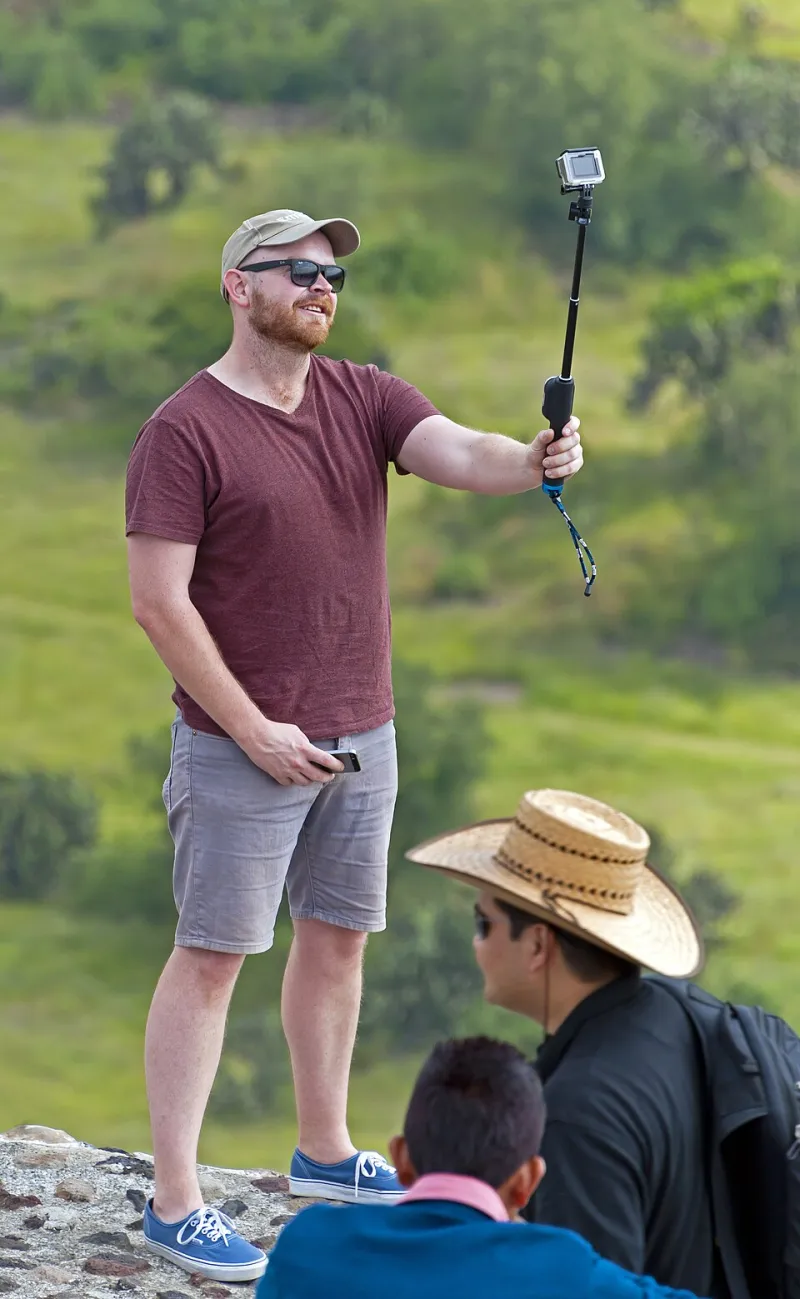
Photo: Daniel Case, CC BY-SA 3.0, via Wikimedia Commons
There is a photograph taken at the Grand Canyon in the summer of 2015 that, in retrospect, captures something essential about the decade. A woman stands at the South Rim, arm extended, a telescoping metal rod gripped firmly in her hand, her phone angled downward to capture both her expression and the vast geological drama behind her. She is looking not at the canyon — one of the most astonishing landforms on the planet — but at a three-inch screen. She is checking the frame.
This is not a criticism of that woman. It is, rather, a diagnosis of a cultural condition that the selfie stick both reflected and accelerated: the growing compulsion to experience the world through the mediating lens of documentation, to witness one's own life from the outside in.
The Instrument Arrives
The selfie stick did not appear fully formed from the digital ether. Its conceptual ancestor — a handheld extendable rod for camera mounting — had existed in various patent forms since the early 1980s. What changed in 2013 and 2014 was the convergence of several forces: the proliferation of front-facing smartphone cameras, the institutionalization of Instagram as a social ledger of personal experience, and the mass tourism economy that rewarded the visually compelling proof of presence over the experience of presence itself.
By 2015, selfie sticks were banned at the Smithsonian Institution, the Museum of Modern Art, and the Palace of Versailles. Their prohibition at cultural landmarks was treated, in most news coverage, as a story about safety or crowd management. But the bans revealed something more uncomfortable — that a significant portion of visitors to these sites were spending their time not looking at the art or the architecture, but positioning themselves in relation to it for an audience that was not physically there.
The selfie stick was, in this sense, a physical manifestation of a psychological shift that had been building since the smartphone camera became ubiquitous. It was the hardware upgrade for a software change already running in the American mind.
The Geometry of Self-Placement
What distinguished the selfie stick from simply handing your camera to a stranger was the degree of compositional control it returned to the user — and what that control demanded in return. To use a selfie stick effectively required a specific kind of attentional division: one portion of awareness directed at the actual environment, the remainder devoted to managing angle, lighting, expression, and background coherence.
This division was not neutral. Cognitive research on attention has long established that the act of photographing an experience can impair the depth of memory formed around it — a phenomenon sometimes called the photo-taking impairment effect. The selfie stick did not invent this impairment, but it industrialized it, extending the period during which a person's attention was split between living the moment and producing its record.
The geometry mattered, too. A conventional photograph taken by a companion places the subject within a scene. The selfie stick photograph, by contrast, places the subject in front of a scene, arm extended, face forward, the environment demoted to backdrop. The compositional logic is subtly but meaningfully different: it asserts the primacy of the self over the setting, the individual over the context. The Grand Canyon becomes the thing happening behind you.
Tourism, Performance, and the Proof of Presence
American tourism had always carried an element of social proof — the postcard sent home, the slide show assembled for neighbors, the bumper sticker acquired at Yellowstone. What shifted in the 2010s was the speed and scale of that proof-gathering, and the degree to which the proof had to be not merely documentary but aesthetically persuasive.
Instagram, which reached one hundred million users in 2013, operated on a logic of visual currency. Certain images — sunsets at Santorini, cherry blossoms in Washington, D.C., the neon corridors of the Cosmopolitan in Las Vegas — accrued engagement precisely because they were legible as desirable experiences. The selfie stick was the instrument that allowed an individual to insert themselves into that visual currency, to be not just the person who went somewhere, but the person who went somewhere beautifully.
The result was a feedback loop with genuine consequences for how destinations were chosen, how time was allocated within them, and how attention was distributed once travelers arrived. Theme parks reported visitors spending significant portions of their visit at designated photo locations rather than rides. National parks observed guests bypassing interior trails in favor of the roadside overlooks that offered the most photographically reliable backdrops. The experience was being reverse-engineered from the image.
The Stick as Social Artifact
It would be a mistake to treat the selfie stick as purely a symptom of narcissism, which was the preferred media interpretation when the device reached peak cultural saturation around 2014 and 2015. The impulse it served was more complex and, in certain respects, more sympathetic than that framing allowed.
For solo travelers, the selfie stick solved a genuine practical problem: the social awkwardness of asking strangers to photograph you, the unreliability of those strangers' compositional instincts, the vulnerability of handing over your phone to someone you did not know. For families and groups, it allowed everyone to appear in the same frame without the perpetual sacrifice of one member to the photographer's role. These were not trivial concerns.
What the selfie stick also represented, less visibly, was the democratization of a kind of visual self-narration that had previously required either a professional or a cooperative companion. The solo traveler with a selfie stick was asserting the right to document their own existence on their own terms — a claim with genuine dignity in it, even when the execution was awkward.
What the Frame Could Not Capture
And yet. The decade that the selfie stick inhabited was also a decade in which Americans reported declining rates of presence, attention, and what psychologists term savoring — the capacity to fully absorb a pleasurable experience in the moment of its occurrence. Whether documentation culture caused this decline or merely accompanied it remains genuinely contested. But the correlation was difficult to dismiss entirely.
There is a certain irony in the fact that the selfie stick, designed to better capture the experience, may have contributed to the thinning of the experience itself. The arm extended toward the camera was also an arm extended away from full immersion. The gaze directed at the screen was a gaze redirected from the canyon, the painting, the ceremony, the meal.
The selfie stick did not create the condition it embodied. The condition — an orientation toward life as something to be curated and transmitted rather than simply inhabited — had been developing across the entire arc of social media's rise. The stick was merely the most visible, most physical, most unmistakable expression of that orientation. You could carry it. You could see it in other people's hands. You could, if you were paying attention, recognize in it a mirror.
The decade it defined is now behind us. The stick itself has largely been replaced by gimbals, ring lights, and the front-facing cameras that have grown sophisticated enough to render the extendable rod unnecessary. But the posture it represented — the slight turning away from the moment in order to document it — remains. The arm is still extended. The screen is still between us and the thing we came to see.